
The Many Names of the Qur’an and Their Meanings
There are some things that we use all the time
But that we don’t stop and think about them
We don’t stop and remember to be grateful for them
Like: seeing, breathing, our health, our bodies, and much, much more.
One of those things is the tool that allows you, right now, to understand the ideas we type in this newsletter,
The stories in a book,
The emotions in a letter,
The concepts that are new to you.
That tool is languages.
And it is not a coincidence that our Lord mentions this in the Qur’an as a favor to us:
“The Most Merciful
Taught the Qur’an,
Created man,
[And] taught him eloquence.” [55:1-4]
We are able to understand each other through languages,
But also, thanks to translations, we can even understand people who do not communicate in the same way we do.
However, as amazing as translations can be, they can’t express the full intent of a phrase in another language at a 100%.
That becomes really obvious in the case of the Qur’an.
Translations cannot express the complete meaning carried by the Arabic.
And that limitation becomes obvious when we look at how the Qur’an speaks about itself.
When we say “the Qur’an” in English…
We are using one word.
But the Qur’an does not restrict itself to one word.
It presents itself through multiple names.
And every name highlights a different function.
Not just what it is.
But how it should be lived.
Let’s explore some of the names of our Lord’s Book:
1) Al-Furqān (الفرقان)
Means The Criterion.
Means The Criterion.
It distinguishes between truth and falsehood.
"Blessed is He who sent down the Criterion upon His Servant that he may be to the worlds a warner" [25:1]
2) Al-Kitāb (الكتاب)
Means The Book.
Means The Book.
The written word of Allah for mankind.
"This is the Book about which there is no doubt, a guidance for those conscious of Allāh" [2:2]
3) Adh-Dhikr (الذكر)
Means The Reminder.
Means The Reminder.
It reminds us of Allah and of our purpose.
"It is certainly We Who have revealed the Reminder, and it is certainly We Who will preserve it." [15:9]
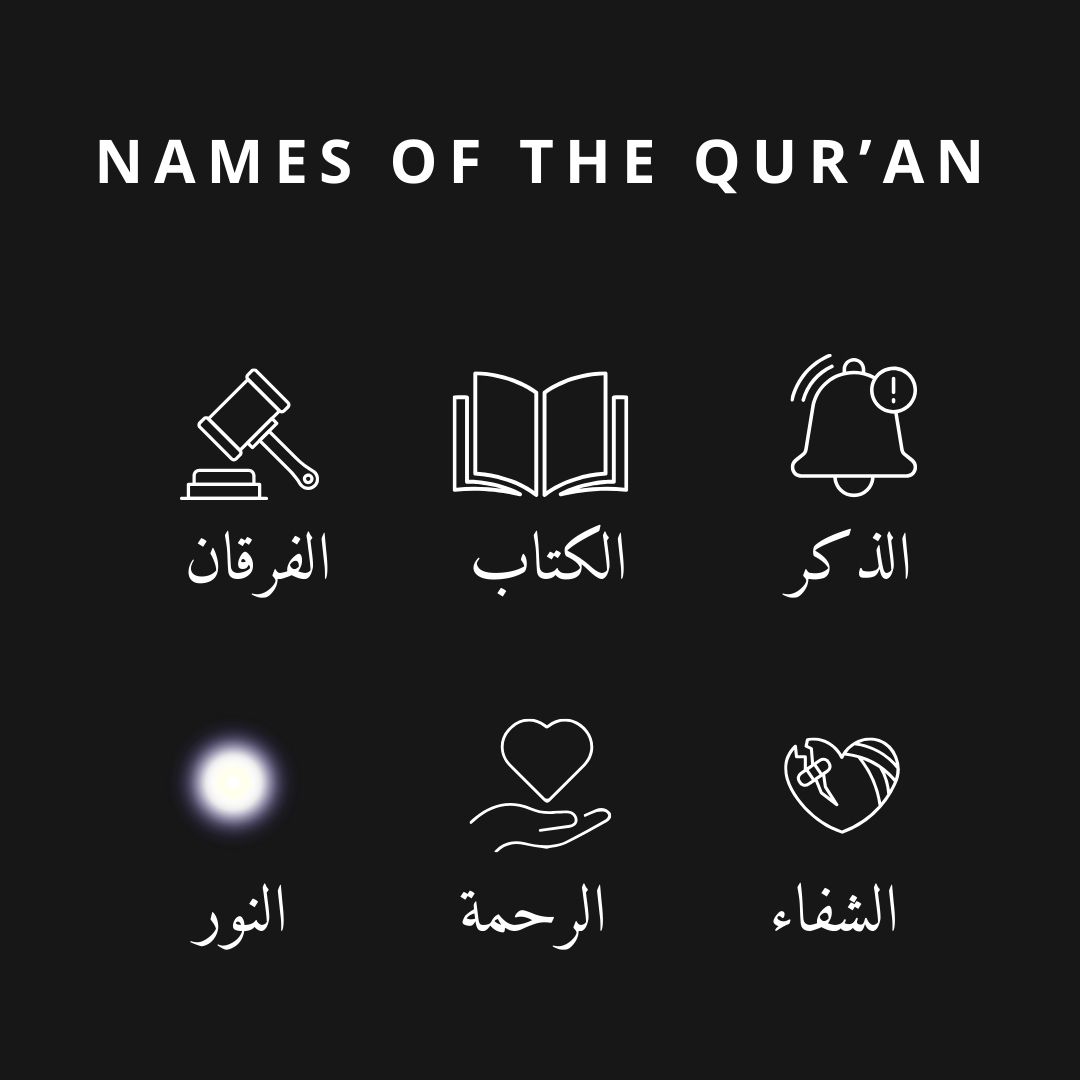
4) An-Nūr (النور)
Means The Light.
Means The Light.
It guides us out of darkness.
"O mankind, there has come to you a conclusive proof from your Lord, and We have sent down to you a clear light." [4:174]
5) Ar-Raḥmah (الرحمة)
Means The Mercy. It brings comfort and reassurance to the heart.
Means The Mercy. It brings comfort and reassurance to the heart.
"O mankind, there has come to you instruction from your Lord and healing for what is in the breasts and guidance and mercy for the believers." [10:57]
6) Ash-Shifā (الشفاء)
Means The Healing. It treats sadness and restores hope.
Means The Healing. It treats sadness and restores hope.
" And We send down of the Qur’ān that which is healing and mercy for the believers, but it does not increase the wrongdoers except in loss."[17:82]
Learning and understanding Arabic opens the door to understanding our religion on a deeper level.
Whether you are a native Arabic speaker or a revert whose language is completely different,
Learning Arabic is one of the best things you can do to grow closer to the Qur’an.
We may read translations.
We may memorize verses in another language.
But the Qur’an was revealed in Arabic for a reason.
Its words carry depth.
Its structure carries meaning.
Its names carry instruction.
And within this Book are du’as taught directly by Allah.
Supplications spoken by prophets.
Du’as revealed in moments of fear, gratitude, weakness, and victory.
If you want to move beyond translation and understand the Qur’anic du’as as they were revealed, Qur’anic Du’as gathers every supplication from the Qur’an in one place, along with its background and meaning, so you know what you are asking for when you raise your hands.
The more we return to its language,
The more we discover that nothing was random.
Nothing was wasted.
And nothing was ordinary.
Every. Single. Word. was chosen.
May Allah open for you the doors of understanding His Book, illuminate your heart with its light, and bless you always with closeness to the Qur’an.
مع حبي (with love),
Eternah
اترك تعليقًا
This site is protected by hCaptcha and the hCaptcha Privacy Policy and Terms of Service apply.