
The Difference Between Backbiting and Sincere Advice ( Ghība vs Naṣīḥa )
“I’m just being honest.”
“I’m thinking about him/her.”
“I’m trying to warn others.”
“I’m just joking.”
We often see people shielding their wrong comments behind these phrases.
Making hurting others the new normal.
Talking harshly about others the new normal.
Even spreading lies about others the new normal.
And we forget that Allah and His Messenger ﷺ condemned this.
“I’m thinking about him/her.”
“I’m trying to warn others.”
“I’m just joking.”
We often see people shielding their wrong comments behind these phrases.
Making hurting others the new normal.
Talking harshly about others the new normal.
Even spreading lies about others the new normal.
And we forget that Allah and His Messenger ﷺ condemned this.
Allah says in the Qur’an:
“O you who have believed, avoid much [negative] assumption. Indeed, some assumption is sin. And do not spy or backbite each other. Would one of you like to eat the flesh of his brother when dead? You would detest it. And fear Allah; indeed, Allah is Accepting of Repentance and Merciful.” [49:12]
And the Prophet ﷺ said:
“Do you know what backbiting is?”
They said: Allah and His Messenger know best.
He ﷺ said:
“It is to mention your brother in a way that he dislikes.”
It was said: “What if what I say is true about him?”
He ﷺ said:
“If what you say is true, you have backbitten him. If it is false, you have slandered him.” [Muslim]
“Do you know what backbiting is?”
They said: Allah and His Messenger know best.
He ﷺ said:
“It is to mention your brother in a way that he dislikes.”
It was said: “What if what I say is true about him?”
He ﷺ said:
“If what you say is true, you have backbitten him. If it is false, you have slandered him.” [Muslim]
But sometimes, the fear of backbiting makes us avoid correcting others.
We stay silent when advice is needed.
We confuse sincere counsel with gossip.
That is why we must understand the difference between ghība (الغيبة) and naṣīḥa (النصيحة) and how to advise others without falling into sin.
1) Ghība (الغيبة)
Root: غ ي ب (ghayb) means to be absent, unseen, or hidden.
It means to mention something about someone in their ghayb, in their absence, that they would dislike if they knew.
To consume the honor of your brother when he is not there to defend himself.
It is not just speaking about someone. It is speaking without them and without mercy.
In day-to-day life:
- Telling others about a friend’s mistakes.
- Commenting negatively on someone’s post or choices.
- Starting a sentence with “I’m not saying it to be mean, but…”
The Prophet ﷺ described it as eating the flesh of your brother.
Because backbiting consumes not only your deeds but your empathy.
It turns compassion into pride.
And it replaces self-awareness with self-righteousness.
2) Naṣīḥa (النصيحة)
Root: ن ص ح (naṣaḥa) means to purify, to make sincere, to mend something.
Naṣīḥa comes from naṣḥ al-ʿasal, when honey is strained of its wax to make it pure.
Giving naṣīḥa means giving advice that is pure of self-interest and free of pride.
To advise with love, not judgment. To seek Allah’s pleasure, not validation.
In day-to-day life:
- Privately reminding someone who wronged you or others.
- Advising a friend who is drifting from salah, not through exposure but through gentle reminders.
- Checking your own intention before you speak. Are you correcting, or are you humiliating?
Naṣīḥa is one of the greatest forms of worship.
Because it requires sincerity, empathy, and wisdom.
It is a mirror polished with mercy, showing others the truth without breaking them.
Because it requires sincerity, empathy, and wisdom.
It is a mirror polished with mercy, showing others the truth without breaking them.
3) Giving advice with adab
There is a fine line between ghība and naṣīḥa.
Both involve speech about others.
But the difference lies in the heart.
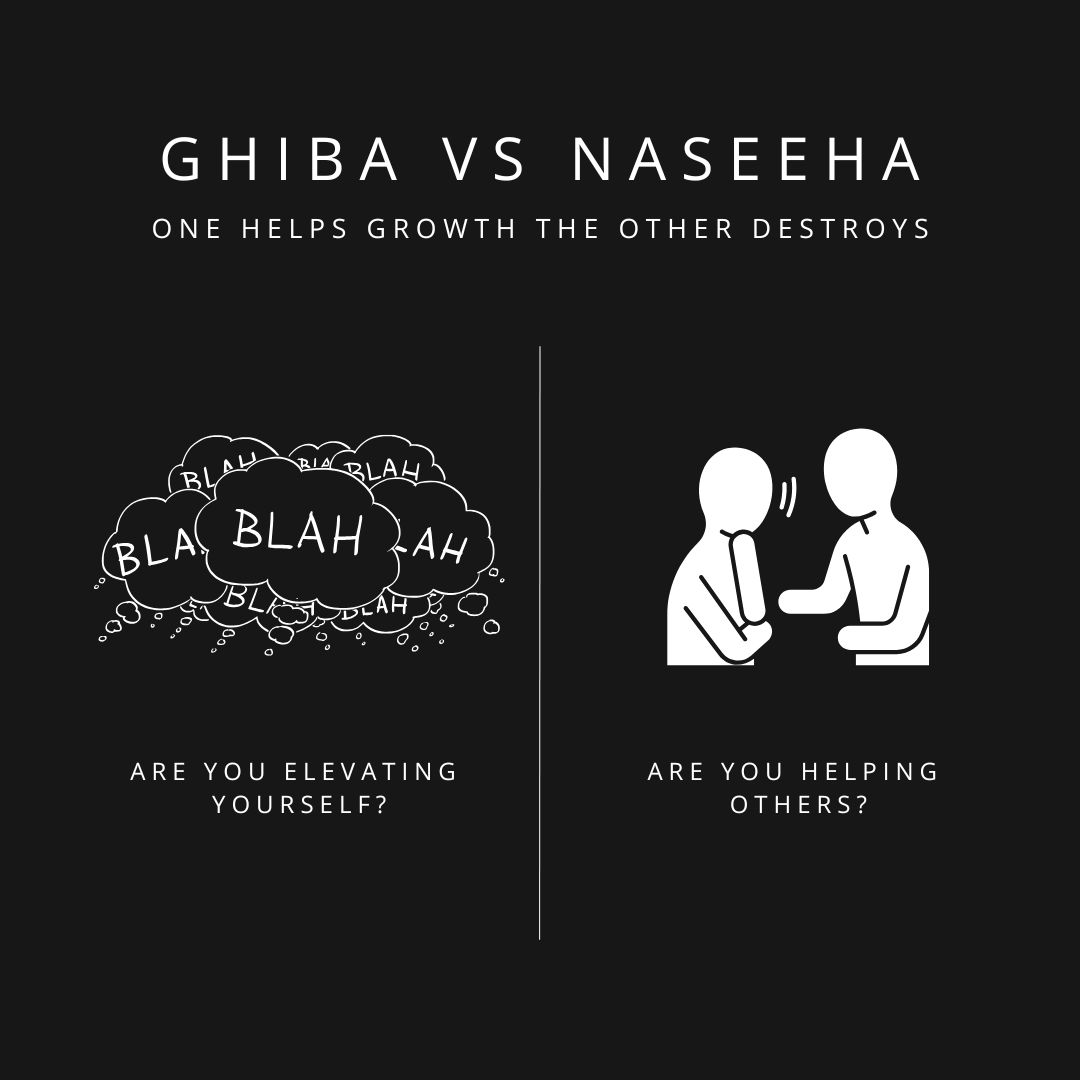
Ghiba exposes.
Naṣīḥa protects.
Both involve speech about others.
But the difference lies in the heart.
Ghiba exposes.
Naṣīḥa protects.
One seeks to elevate the self.
The other seeks to elevate the other.
The Prophet ﷺ said:
“The religion is sincere advice.” [Muslim 55]
So when you see wrong, do not expose it.
Speak with ḥikmah (wisdom).
Speak with luṭf (gentleness).
Speak with ikhlāṣ (sincerity).
The goal is not to prove you are right.
It is to help another Muslim return to what is right.
Sins of the tongue are often the most neglected because they are light on the lips but heavy on the scales.
If you wish to purify your speech, begin by purifying your heart through reflection.
The Juz 30 Qur’an Journal was designed to help you do that. To reflect, to write, and to return.
Each surah guides your thoughts back to Allah, and every page gives space for reflection, tafsir, and self-correction.
Begin with the tongue that recites Qur’an.
And bring barakah to yourself and others through your words.
May Allah purify your words, cleanse your intentions, and make your speech a source of reward.
May He make your advice gentle and your heart sincere.
May Allah bless you always.
مع حبي (with love),
Eternah
اترك تعليقًا
This site is protected by hCaptcha and the hCaptcha Privacy Policy and Terms of Service apply.