
How to do Tawbah
A sign of a healthy heart is guilt
Why?
Because it proves your heart can still tell the difference between right and wrong.
Sometimes we take that for granted.
As if everybody had that compass.
But that could not be farther from the truth.
When we look at history, we see how unfazed people can be by the suffering of others.
And we do not even need to look at the past. Just look at today’s world.
Today’s wars.
Today’s famine.
Today’s hunger.
To see that there is an epidemic of sealed hearts.
Stone hearts.
Hearts that fight so hard against their fitrah, they forget themselves and start to believe the distortion is their nature.
So what can the Muslim of today do to keep the compass alive and the heart soft?
Why?
Because it proves your heart can still tell the difference between right and wrong.
Sometimes we take that for granted.
As if everybody had that compass.
But that could not be farther from the truth.
When we look at history, we see how unfazed people can be by the suffering of others.
And we do not even need to look at the past. Just look at today’s world.
Today’s wars.
Today’s famine.
Today’s hunger.
To see that there is an epidemic of sealed hearts.
Stone hearts.
Hearts that fight so hard against their fitrah, they forget themselves and start to believe the distortion is their nature.
So what can the Muslim of today do to keep the compass alive and the heart soft?
The answer is simple.
Turn back to Allah.
Al-Ghafur.
By asking for His forgiveness. In short, by doing tawbah.
You might not be a stranger to the concept.
But have you ever wondered, what is the best way, the most beloved way, to turn back to our Lord?
Let us explore the way of making tawbah in the Sunnah.
1) Always start with niyyah
Make the intention in your heart to leave the sin for the sake of Allah.
You realize what you did was wrong.
You feel ashamed.
You feel guilty for your heedlessness.
So you dispose yourself to ask forgiveness from the All-Forgiving, and to leave that sin for Him.
Make the intention in your heart to leave the sin for the sake of Allah.
You realize what you did was wrong.
You feel ashamed.
You feel guilty for your heedlessness.
So you dispose yourself to ask forgiveness from the All-Forgiving, and to leave that sin for Him.
2) Follow the Sunnah and pray
“When a servant [of Allah] commits a sin, and he performs ablution well, and then stands and prays two rak’ahs, and asks pardon of Allah, Allah pardons him.” [Abi Dawud 1521]
Beyond our daily obligations, prayer after sin is a chance to stand before Him out of love.
We want His forgiveness.
We want His pleasure.
We want to be far from His displeasure.
So we stand in prayer and ask for His mercy.
“When a servant [of Allah] commits a sin, and he performs ablution well, and then stands and prays two rak’ahs, and asks pardon of Allah, Allah pardons him.” [Abi Dawud 1521]
Beyond our daily obligations, prayer after sin is a chance to stand before Him out of love.
We want His forgiveness.
We want His pleasure.
We want to be far from His displeasure.
So we stand in prayer and ask for His mercy.
And when in sujood, say as the Prophet ﷺ did:
“O Allah, forgive me all my sins, small and big, first and last, open and hidden.” [Muslim 483]
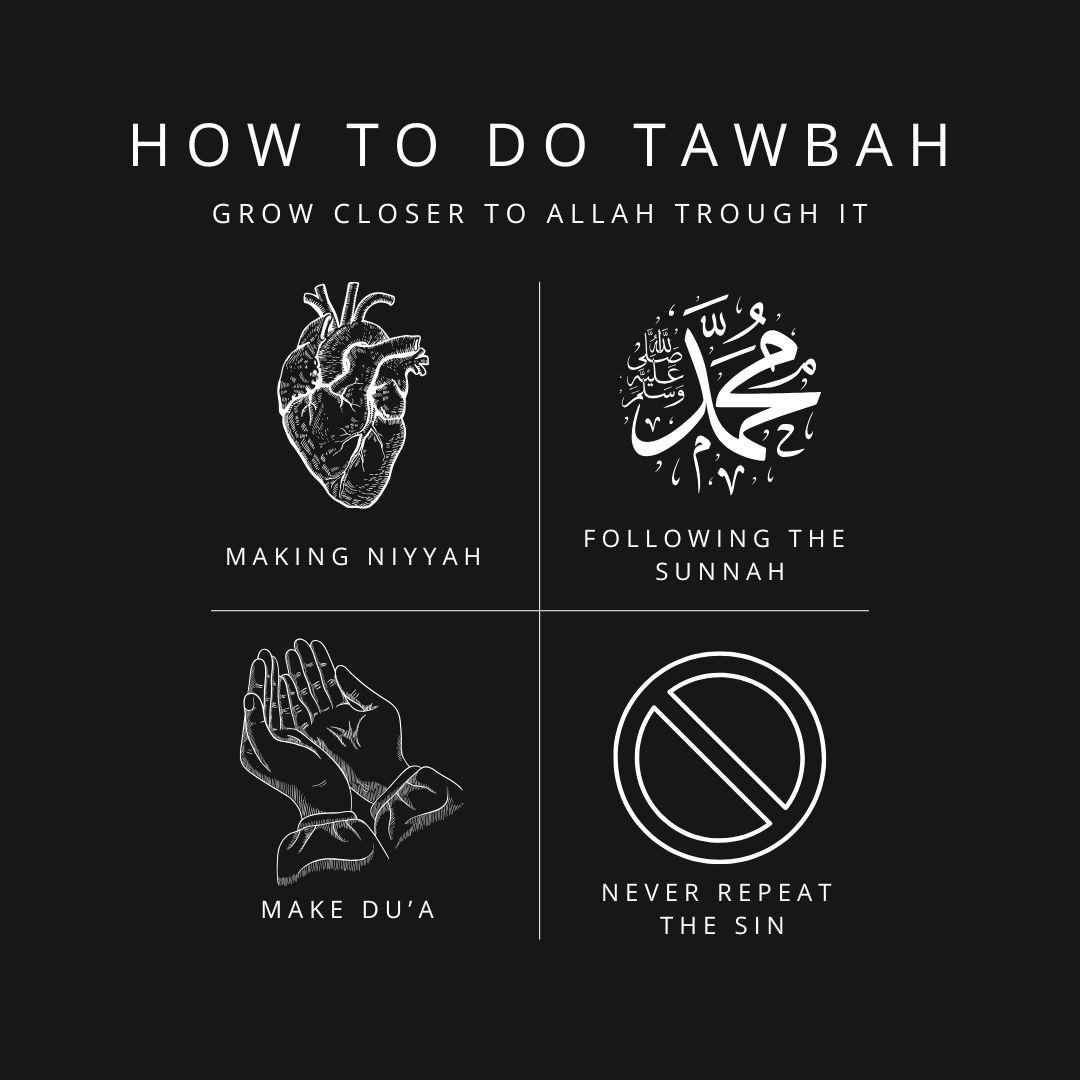
3) Make du’a to Allah
Long or short.
In Arabic or English.
What matters is your heart and your intention.
Call upon your Lord and pour your soul to Him.
A good place to start is Sayyidul Istighfar, the best du’a for forgiveness:
Long or short.
In Arabic or English.
What matters is your heart and your intention.
Call upon your Lord and pour your soul to Him.
A good place to start is Sayyidul Istighfar, the best du’a for forgiveness:
“O Allah, You are my Lord, there is no god but You.
You created me and I am Your servant.
I keep my promise and covenant to You as best I can.
I seek refuge in You from the evil of what I have done.
I admit Your blessings upon me, and I admit my sins.
So forgive me, for none forgives sins except You.” [Bukhari 6306]
Or a short du’a for any moment:
“I seek Allah’s forgiveness and I turn to Him.” [Bukhari 6307]
4) Promise never to return to that sin
The Prophet ﷺ said:
The Prophet ﷺ said:
“Allah is more pleased with the repentance of His servant than one of you who loses his camel that carries his provision of food and drink in the desert and suddenly finds it.”
[Muslim 2747]
The final step.
The one that seals everything.
You already asked for forgiveness.
Now commit not to go back.
Not back to humiliation.
Not back to ignorance.
Tawbah is accepted until the door of death arrives.
No matter how many times you fall, Allah still wants you to return.
Do not deny yourself that chance.
Go back to Him.
Not back to humiliation.
Not back to ignorance.
Tawbah is accepted until the door of death arrives.
No matter how many times you fall, Allah still wants you to return.
Do not deny yourself that chance.
Go back to Him.
Tawbah begins with turning back to Allah, but it continues with keeping your heart connected to His words.
The Juz 30 Qur’an Journal was designed to help you reflect, record your tafsir notes, and stay consistent with your Qur’an journey.
May Allah keep your heart soft, your steps firm, your repentance sincere, and your connection to His Book a source of light in this world and protection in the next.
مع حبي (with love),
Eternah
اترك تعليقًا
This site is protected by hCaptcha and the hCaptcha Privacy Policy and Terms of Service apply.